
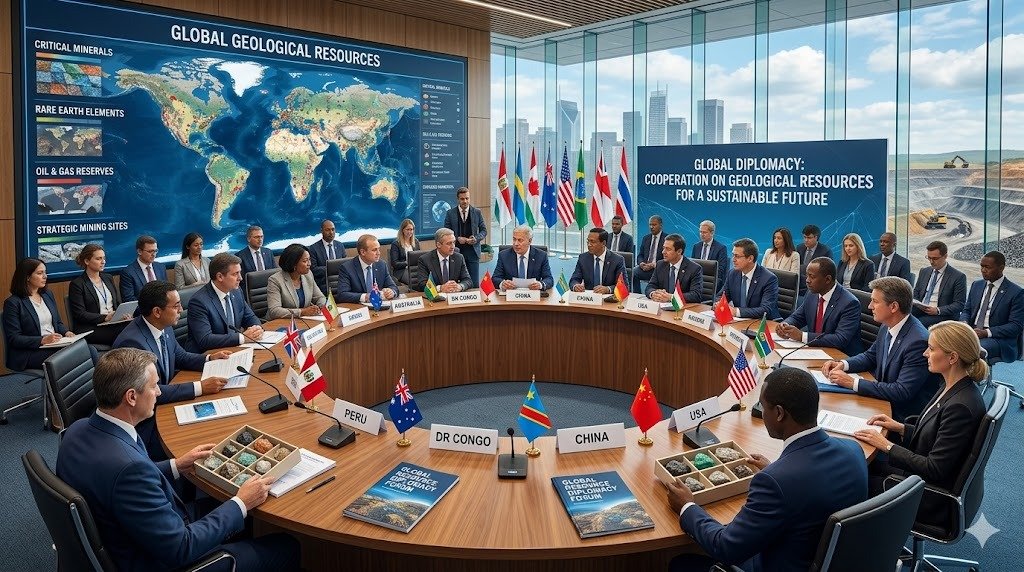

In earlier times, the strength of a country was usually measured by the size of its army or the speed of its supercomputers. However, in 2026, the true source of global influence has shifted deep into the Earth’s crust. Geology—the study of rocks and the Earth’s physical makeup—is no longer just a subject for researchers; it has become a vital tool for ensuring a nation’s security and prosperity. Today, the materials found beneath a country’s soil determine its importance on the world stage, especially as we witness a massive global race for “critical minerals” like lithium, cobalt, and copper. These minerals are often called the “new oil” because they are essential ingredients for modern technology and for transitioning from fossil-fuel-powered vehicles to electric ones. Because these minerals are found only in very specific geological settings formed by ancient volcanoes or shifting tectonic plates, the few countries that possess these deposits now hold immense power over global supply chains.
This shift toward valuing what lies underground brings about a “green dilemma,” a situation in which solving one problem creates another. To reduce reliance on fossil fuels and combat climate change, we must build millions of electric vehicles, wind turbines, and solar panels. However, their production requires large-scale mining projects that can harm the environment. This creates a delicate balance between extracting the Earth’s resources and protecting the surrounding ecosystems.
Furthermore, the physical Earth is changing in ways that threaten global security. Rising temperatures trigger geohazards such as massive landslides and the melting of permafrost—the permanently frozen ground in polar regions. When this ice melts, it not only damages infrastructure but also releases gases that further accelerate global warming. At the same time, rising sea levels are eroding coastlines and altering maritime boundaries, forcing nations to rely on detailed geological mapping to safeguard their territories. Deep beneath the surface, another silent crisis is unfolding as groundwater is extracted for agriculture at such a rapid pace that land subsidence is occurring in many regions.
For India, these geological challenges present a significant opportunity to emerge as a global leader. To secure its future, India is developing a comprehensive digital map of its subsurface resources to identify hidden mineral reserves, a process that has already led to the discovery of substantial lithium deposits. These minerals are crucial for advancing modern technologies; however, lithium is rarely found in isolation and is often associated with other valuable metals such as titanium and bauxite. To address this, India is adopting an innovative technique known as “Direct Lithium Extraction.” This advanced, multi-mineral approach enables the simultaneous extraction of multiple resources from a single site. By doing so, India can reduce costs, minimize waste, and ensure that mining remains both economically viable and environmentally responsible.
Successfully harnessing these resources will position India as a key player in global supply chains through what is known as “geoscience diplomacy.” This form of diplomacy strengthens India’s global standing and fosters collaborative partnerships, reducing the risk of any single nation dominating critical resources. It also plays a crucial role in uniting countries to address shared challenges such as natural disasters and resource scarcity. Ultimately, geoscience diplomacy is essential for a more stable and peaceful world; when nations cooperate and share knowledge about the Earth beneath them, natural resources can become a bridge for cooperation rather than a source of conflict.
The writer of this article, Dr. Yudhbir Singh, is an Associate Professor in the Department of Geology at the University of Jammu, J&K, India.