
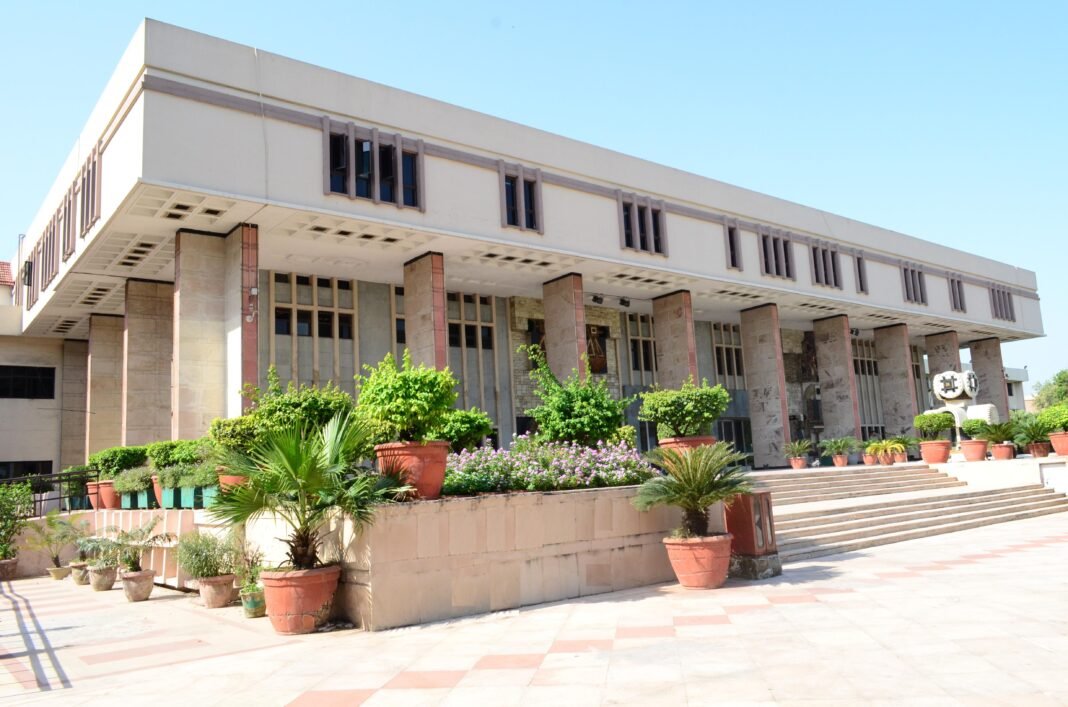

The Delhi High Court on Thursday began hearing arguments on a batch of petitions challenging several provisions of the Unlawful Activities (Prevention) Act (UAPA), a law often criticised for its sweeping definitions and stringent bail restrictions.
A Bench of Chief Justice Devendra Kumar Upadhyaya and Justice Tejas Karia took up four petitions, including one filed by the Foundation for Media Professionals (FMP). Senior Advocate Arvind Datar appeared for FMP and opened the submissions.
What Is Being Challenged
Datar said the organisation has questioned the constitutional validity of several sections:
- Section 2(1)(o)(iii) – defines “unlawful activity” to include causing or attempting to cause disaffection against India.
- Section 43D(4) – bars anticipatory bail in UAPA cases.
- Proviso to Section 43D(5) – prohibits bail if the case diary suggests the accusations are prima facie true.
- Sections 35 and 36 – empower the government to designate individuals and organisations as “terrorists” or “terror organisations”.
“A Journalist Can Be Jailed for Criticism”
Targeting Section 2(1)(o)(iii), Datar argued that the definition of “unlawful activity” is vague, overly broad, and arbitrary, leaving enormous room for abuse.
Representing a journalists’ group, he told the court that ordinary criticism could now be criminalised:
“A journalist saying the AI Summit is going wrong may be jailed. I may criticise a mining policy. It may show India in a bad light, but as long as I am not inciting or promoting violence, that’s not unlawful — it’s democracy.”
He said the provision creates a constant fear that any criticism of government policy could be treated as disaffection towards the country.
Challenge to Bail Restrictions
Datar also questioned Section 43D(4), which prohibits anticipatory bail under UAPA. He pointed out that the Bharatiya Nyaya Sanhita (BNS) contains similar offences, but anticipatory bail is permitted there.
This, he argued, makes the UAPA bar on anticipatory bail violative of Article 14 (right to equality).
Case Diary Cannot Be Basis for Bail Denial
On the proviso to Section 43D(5), which ties bail to the contents of a case diary, Datar said this approach is fundamentally flawed.
Courts, he noted, have held since 1897 that case diaries cannot be treated as evidence:
“A case diary can only be used to contradict the police officer. It cannot be the basis to deny someone their liberty.”
Designation of Individuals as Terrorists
Sections 35 and 36, which allow the government to designate people as “terrorists,” were challenged for granting excessive executive power without adequate safeguards, though Datar focused Thursday’s arguments on the definitional and bail-related provisions.
Hearing to Continue March 16
After hearing Datar for some time, the Bench adjourned the matter. Arguments will resume on March 16.