
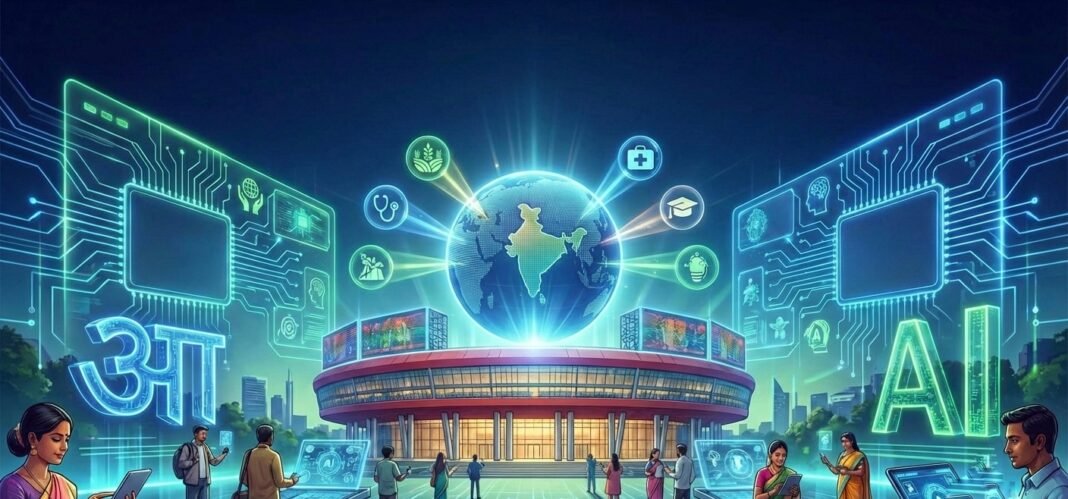

The India–AI Impact Summit 2026 is currently taking place (February 16–20) at Bharat Mandapam, New Delhi. It is a landmark event as it’s the first global AI summit hosted in the Global South, focusing on moving beyond theoretical talk and for measurable outcomes. The AI market in India has seen explosive growth, becoming a cornerstone of the national economy. Estimated at over $25 billion in 2026, with projections suggesting AI will add between $500–600 billion to India’s GDP by 2030. AI adoption is no longer limited to IT. It is driving a 9.7% growth in the advertising market and significantly boosting productivity in the Micro, Small, and Medium Enterprises (MSME) sector.
Under the IndiaAI Mission, the government has been onboard over 38,000 GPUs (Graphic Process Unit) to provide shared, affordable compute access to startups and researchers. Indigenous Models development is underway for 12 foundation models tailored specifically to Indian languages via Bhashini — an Indian Government AI platform — and local cultural contexts. A massive allocation of over ₹10,300 crores investment (approx. $1.25 billion) is fueling this ecosystem of Ai.
India’s future vision for AI is encapsulated in the slogan “Make AI in India, Make AI Work for India.” By 2026, the strategy has moved beyond just digital infrastructure to a goal of becoming one of the top three AI superpowers globally. Here is the roadmap for India’s AI future across its key pillars. India’s long-term goal is to integrate AI into every facet of the economy to achieve a “Developed India” by 2047. Economic Contribution: AI is projected to add $1.7 trillion to the Indian economy by 2035. Technology Sector Growth: NITI Aayog has outlined a roadmap to grow the technology sector from $300 billion to $820 billion by 2035, driven specifically by Agentic AI and “India-for-India” solutions.
India aims to reduce reliance on foreign tech giants by building its own “AI Stack.” Compute Scalability: Following the success of the current 38,000 GPU network, the government has announced plans to further expand this capacity to ensure startups and researchers have “plug-and-play” access to affordable high-end compute. Indigenous Foundation Models: A major aim is the development of BharatGen, a sovereign AI initiative to create Multimodal Large Language Models (LLMs) trained specifically on Indian languages and cultural nuances. Domestic Hardware: India aims to design and manufacture its own indigenous GPUs within the next 3 to 5 years.
India intends to act as a bridge between the developed world and developing nations. Global Provider: The aim is for India to be the “Service Provider for the World,” exporting its AI-based public goods (like AI-enabled healthcare and agriculture tools) to other developing countries. Template for Governance: India is positioning its “Responsible AI” framework — which uses existing laws supplemented by targeted AI amendments — as a low-cost, high-innovation template for the Global South.
The future focus is on People, Planet, and Progress. Healthcare: Moving from diagnostics to AI-driven drug discovery and personalized medicine for 1.4 billion people. Agriculture: Real-time AI advisory for every farmer to combat climate change and optimize crop yields. Education: Achieving 100% digital literacy where AI tutors provide personalized, multilingual education in every village. Governance: 100% “Paperless and Intelligent” governance where AI automates everything from court judgment translations to tax processing.
| Goal | Target Year | Objective |
|---|---|---|
| Market Size | 2030 | $500B+ AI contribution to GDP |
| GPU Capacity | 2027–28 | Massive expansion beyond the current 38k units |
| Viksit Bharat | 2047 | Full integration of AI in national development |
| Indigenous GPU | 2029 | Reducing reliance on global hardware imports |
The India–AI Impact Summit 2026 is the first-ever global AI summit hosted in the Global South, taking place from February 16–20, 2026, at Bharat Mandapam, New Delhi. It marks a shift from theoretical AI safety discussions (seen in past summits in the UK and Korea) to actionable impact and inclusive growth. The summit is built on a foundational philosophy aimed at ensuring AI serves humanity rather than just commercial interests. The summit aims to develop AI that empowers citizens through healthcare, education, and financial inclusion, further using AI for climate resilience, sustainable agriculture, and resource efficiency. There is a requirement to harness Ai for economic growth, digital sovereignty, and efficient governance.
The deliberations are organized into seven working groups focused on specific global challenges: Inclusion for Sociial Empowerment: Multilingual AI and gender equity. Safe & Trusted AI: Ethical governance and deepfake mitigation. Resilience, Innovation, and Efficiency: Strengthening supply chains and industries. Science: AI for drug discovery and advanced research. Democratizing AI Resources: Affordable compute and data access for all. AI for Economic Growth & Social Good: Large-scale public service delivery. Sectoral Casebooks: The government launched six “AI Impact Casebooks” showcasing 170+ scalable innovations already deployed in health, agriculture, and energy.
Global Impact Challenges: Grand finales for AI for ALL, AI by HER, and YUVAi are identifying top startups and student-led AI solutions. Major Investments: *Google announced a $15 billion push for AI infrastructure and skilling in India. Research Symposium: Today (Feb 18) featured a global symposium with IIIT Hyderabad, showcasing 250+ research papers focused on Global South challenges.
The 2026 AI Summit represents a landmark shift from speculative caution to unified global action. Its primary triumph is the establishment of a “Safety-First” governance model that harmonizes rapid innovation with ethical oversight. By securing international commitments to bridge the digital divide and prioritize AI for climate and healthcare solutions, the summit redefined the technology as a universal utility rather than a competitive weapon. The summit, often referred to as the “Magna Carta of AI” for the Global South, shifted the global conversation from purely “existential risk” to development-oriented AI.
The core outcomes are structured around the M.A.N.A.V. Vision and the Three Sutras. Prime Minister Narendra Modi unveiled this five-point framework to ensure AI remains a tool for human empowerment: Moral and Ethical Systems: Prioritizing human values over raw data processing. Accountable Governance: Establishing clear liability for AI-driven outcomes. National Sovereignty: Protecting citizen data and ensuring nations aren’t just “data exporters.” Accessible and Inclusive AI: Bridging the digital divide, especially for the Global South. Valid and Legitimate Systems: Combating deepfakes through mandatory “authenticity labels” (similar to food labeling).
The summit finalized several groundbreaking resolutions aimed at democratizing technology. This policy framework represents a pivotal shift in the global digital order. By 2026, the conversation has moved beyond mere “AI ethics” and into the realm of Digital Sovereignty — the right of nations and individuals to control their own computational destiny. The rapid evolution of Artificial Intelligence has created a dual-track world: those who own the “compute” and those who are merely data sources. To bridge this gap, international bodies and sovereign states have pivoted toward a model of “AI for Public Good,” defined by five critical resolution areas.
The “Democratizing Compute” movement treats processing power as a public utility, similar to water or electricity. By establishing AI Commons, startups and developing nations are no longer priced out by the trillion-dollar valuations of “Big Tech.” Shared GPU clusters allow for a decentralized innovation ecosystem, ensuring that the next breakthrough in medicine or climate science can come from a garage in Nairobi just as easily as a lab in Palo Alto. For years, global tech giants have treated the internet as a “digital frontier” to be mined. The stance against AI Extractivism asserts that local data — linguistic nuances, healthcare records, and cultural archives — belongs to the community that generated it. This resolution mandates that the benefits of AI (better diagnostics, personalized education) must flow back to the local population rather than being exported as corporate profit.
A model trained primarily on Western datasets will naturally reflect Western biases. By building Indigenous Foundation Models, countries ensure that their AI speaks their language — literally and culturally. These sovereign tech stacks are essential for maintaining national identity in an automated world, allowing for “Vikas” (progress) that is rooted in local values. To prevent the collapse of the creative arts, the proposed Statutory Licensing Regime forces a “Grand Bargain.” AI firms can no longer train on copyrighted works for free. Instead, a transparent royalty system ensures that every time a model learns from a human creator, that creator is compensated. This turns AI from a replacement for human art into a partner that sustains it financially.
Finally, AI is being drafted into the fight against the climate crisis. By integrating AI into Smart Grids, nations can manage the volatile nature of renewable energy. These systems use predictive modeling to balance supply and demand in real-time, making “Net Zero” a data-driven reality rather than a political aspiration. These resolutions move AI from a tool of centralization to a tool of empowerment. By balancing innovation with protection, we ensure that the intelligence of the future is not just “artificial,” but also equitable.