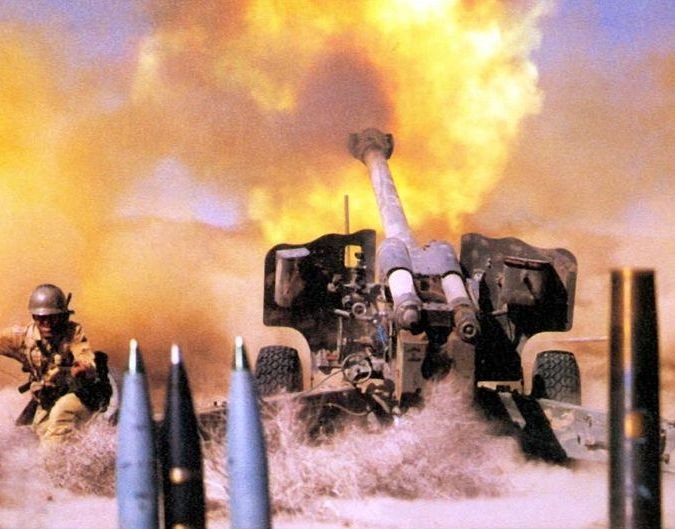

On the morning of 22 September 1980, Iraqi warplanes swept across the border and struck ten Iranian airfields. Within hours, Iraqi armoured columns were rolling into Iran along a 644-kilometre front. Saddam Hussein, Iraq’s strongman president, had gambled that a swift, decisive campaign would topple the new revolutionary government in Tehran, reclaim disputed territory, and establish Iraq as the undisputed power of the Persian Gulf. He was catastrophically wrong.
What followed was eight years of grinding, industrial-scale warfare — trench battles, missile exchanges, chemical weapons attacks, and an unrelenting human toll — that would ultimately claim somewhere between 450,000 and 500,000 lives and leave neither side with anything to show for it. When a United Nations-brokered ceasefire finally took effect in August 1988, the front lines had returned almost exactly to where they had been on the eve of invasion. In his foreword to the 2012 collection Becoming Enemies: U.S.–Iran Relations and the Iran–Iraq War, 1979–1988, former CIA analyst Bruce Riedel described the conflict as “one of the largest and longest conventional interstate wars since the Korean conflict ended in 1953,” and “the only war in modern times in which chemical weapons were used on a massive scale.” A half million lives had been lost, Riedel estimated — perhaps a million more wounded — at an economic cost exceeding one trillion dollars.
A Border Dispute with Deep Roots
The origins of the Iran–Iraq War stretch back decades, rooted in overlapping territorial grievances, ethnic tensions, and ideological rivalry. At the heart of the dispute was the Shatt al-Arab, the strategic waterway formed by the confluence of the Tigris and Euphrates rivers that marks the two countries’ southern border and empties into the Persian Gulf.
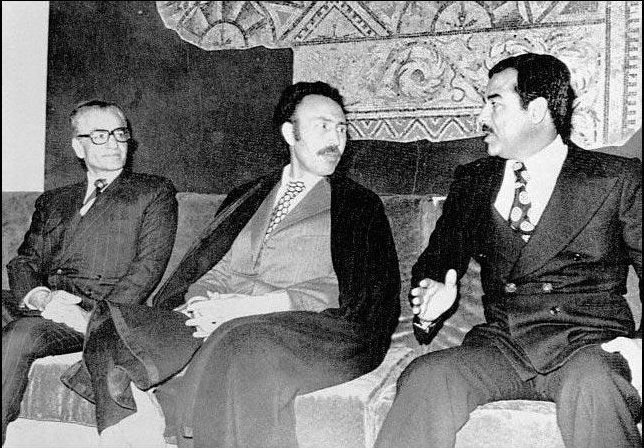
In 1937, Iran and Iraq signed a treaty granting Iraq control over much of the river, with Iranian ships required to pay navigation tolls. The arrangement held uneasily until 1969, when the Shah of Iran, Mohammad Reza Pahlavi, unilaterally renounced it, asserting that the terms had been inequitable. Iraq threatened war but backed down, outmatched by Iran’s stronger military at the time. Tensions simmered for six years until the 1975 Algiers Agreement saw Iraq cede to Iran the eastern bank of the Shatt al-Arab in exchange for Iran withdrawing support from Kurdish insurgents fighting within Iraq. It was a concession Hussein never accepted and never forgot.
Relations briefly thawed in 1978, when Iranian intelligence uncovered a pro-Soviet coup plot against the Iraqi government. In gratitude, Saddam expelled from Iraq one Ruhollah Khomeini — the exiled Shia cleric who had been quietly leading opposition to the Shah from Iraqi soil. The gesture would prove deeply ironic. The following year, Khomeini returned to Iran in triumph, leading a revolution that toppled the Shah and transformed Iran into an Islamic Republic.
The Revolution Changes Everything
For Saddam Hussein, the 1979 Iranian Revolution was simultaneously a threat and an opportunity. In their landmark study The Iran–Iraq War: A Military and Strategic History, published by Cambridge University Press in 2014, military historians Williamson Murray and Kevin Woods document how the revolution created a seismic shift in regional dynamics that Baghdad could not ignore — and how Hussein moved swiftly to exploit it.
Khomeini’s new government explicitly called on Iraq’s Shia majority — long suppressed under Ba’athist rule — to rise up and overthrow their secular government. Hussein, whose Ba’ath Party was dominated by Sunni Arabs but ruled a country with a Shia majority, viewed this as an existential provocation. In July 1979, he made one conciliatory gesture, delivering a speech praising the revolution and calling for Iraqi-Iranian friendship. When Khomeini rebuffed him and renewed his calls for Islamic revolution in Iraq, any remaining diplomatic possibility evaporated.
The opportunity Hussein perceived lay in Iran’s sudden military weakness. The revolution had been followed by a brutal purge of the armed forces. According to Murray and Woods in The Iran–Iraq War: A Military and Strategic History, between February and September 1979, the Iranian government executed 85 senior generals and forced many more into early retirement. By September 1980, approximately 12,000 officers had been purged at all levels, and the desertion rate had reached 60 per cent. On the eve of the revolution, international military experts had ranked Iran’s armed forces among the world’s five most powerful. Within months, they had been gutted.
Hussein had been rebuilding Iraq’s military since his humiliation in the 1975 Algiers Agreement, purchasing vast quantities of Soviet tanks and aircraft throughout the 1970s. By the time of the invasion, according to Murray and Woods, Iraq possessed 242,000 soldiers — second only to Egypt in the Arab world — along with 2,350 tanks and 340 combat aircraft. Iraqi military intelligence reported in July 1980 that Iran, despite its bellicose rhetoric, had “no power to launch wide offensive operations against Iraq, or to defend on a large scale.” The window seemed open. Hussein ordered the invasion.
Iraq’s opening assault was designed as a rapid, overwhelming blow. The Iraqi Air Force’s strikes on Iran’s airfields on 22 September were intended to destroy Iranian air power on the ground. They failed. Iran had built hardened aircraft shelters, and while Iraqi strikes damaged infrastructure, they did not destroy a significant number of aircraft. The following day, Iran retaliated with Operation Kaman 99, sending fighter jets deep into Iraq to strike oil facilities, dams, petrochemical plants, and airbases. Iraq was caught off guard by the ferocity and depth of the counterattack.
On the ground, four Iraqi divisions swept into the oil-rich southwestern province of Khuzestan, laying siege to the vital port cities of Abadan and Khorramshahr. Two more divisions invaded across the central and northern fronts. In his 1989 survey World Conflicts: A Comprehensive Guide to World Strife Since 1945, Patrick Brogan described the Iraqi troops advancing into Iran as “badly led and lacking in offensive spirit” — a damning early verdict on an army that had expected a walkover and found something far more stubborn.
Hussein had hoped the invasion would spark an uprising among Khuzestan’s Arab population. It did not. The Arabs of the province remained loyal to Iran. By December 1980, after less than three months of fighting, the Iraqi advance had stalled. The rapid victory Hussein had counted on was gone.
Iran Strikes Back: 1982 and the Turning Tide
The following two years saw Iran’s reconstituted military — bolstered by the newly created Islamic Revolutionary Guard Corps (IRGC) and its subordinate Basij paramilitary volunteers — claw back lost territory with a series of determined offensives. The Basij, founded in direct response to the invasion, was a force unlike any other: poorly armed, drawn from volunteers as young as 12 and as old as 70, and animated by revolutionary and religious fervour. Subordinate to the Revolutionary Guard, as Murray and Woods note in The Iran–Iraq War: A Military and Strategic History, the Basij provided the mass manpower that drove the Guard’s most costly human wave attacks.
By June 1982, Iranian forces had recaptured all territory lost in the initial Iraqi assault. The battle for Khorramshahr — a port city that changed hands twice amid savage street fighting and earned the epithet “City of Blood” — became one of the war’s defining episodes, with Iranian forces ultimately recapturing it in a moment of enormous popular celebration.
Having expelled the Iraqis, Khomeini faced a historic decision: stop at the border, or pursue the war into Iraq. He chose to invade — a decision that transformed the character of the conflict and prolonged it by six more years. Iran’s stated war aim became the overthrow of Saddam Hussein’s government and the export of Islamic revolution.
The Long Stalemate: Trenches, Gas, and Missiles
What followed was a grim, grinding war of attrition with disturbing echoes of the First World War. Both sides dug in along fortified lines. Iran launched a series of massive offensives — bearing names like Operation Karbala and Operation Badr — that threw tens of thousands of soldiers against elaborately prepared Iraqi defences. The human cost was staggering. Operation Badr in March 1985, which, according to Murray and Woods’s Military and Strategic History, involved 100,000 Iranian soldiers with 60,000 more in reserve, resulted in 15,000 Iranian casualties and between 10,000 and 12,000 Iraqi ones, yet changed nothing strategically.
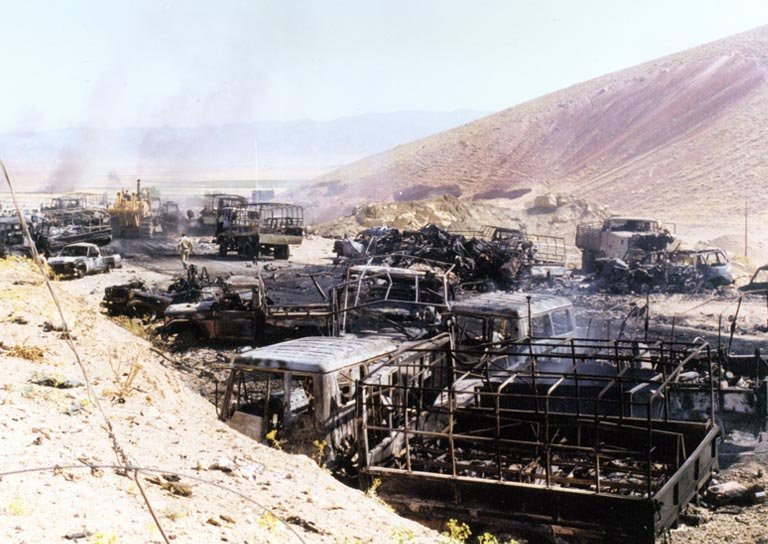
Reporting for the Center for Strategic and International Studies in their study The Lessons of Modern War — Volume II: The Iran–Iraq War, analysts found that by 1984, Iran’s total losses were estimated at 300,000 soldiers and Iraq’s at 150,000. Foreign analysts watching the conflict agreed that both sides had failed to leverage their modern equipment effectively, that internal military coordination was poor, and that abandoned equipment littered the battlefield because neither side could sustain adequate repairs. The war, by the end of 1984, had settled into paralysis.
Iraq’s most infamous resort in breaking that paralysis was the use of chemical weapons — a campaign that stands as one of the war’s most enduring atrocities. In his 2007 book A Poisonous Affair: America, Iraq, and the Gassing of Halabja, former Human Rights Watch official Joost Hiltermann documents how Iraq escalated its chemical attacks dramatically through the mid-1980s, deploying mustard gas and nerve agents against Iranian positions with increasing scale and frequency. In 1991, the CIA estimated that Iran had suffered more than 50,000 casualties from Iraq’s use of chemical weapons; current estimates, accounting for long-term health effects, place the total above 100,000. According to a 2002 report by journalist Farnaz Fassihi for the New Jersey Star-Ledger, as of that year 5,000 of the 80,000 survivors were still seeking regular medical treatment, with 1,000 remaining hospital inpatients.
In June 1987, the Iraqi military crossed a threshold of particular horror: for the first time, it attacked a civilian population centre with chemical weapons, striking the Iranian border town of Sardasht with mustard gas bombs. Five thousand people were stricken; 113 died immediately, with many more succumbing to complications over the following decades. According to a January 2014 report by journalist Robin Wright in Time magazine, Iran remains to this day deeply haunted by the memory of these chemical attacks — a wound that has shaped its strategic calculus, including its views on weapons of mass destruction, ever since.
International Dimensions: A War of Proxies and Self-Interest
The Iran–Iraq War was never a purely bilateral conflict. It drew in the great powers, regional states, and a dizzying array of arms suppliers, each with its own interests to protect or advance.
Iraq enjoyed the more powerful support coalition. The United States, the Soviet Union, France, Britain, and most Arab states backed Baghdad in various ways. In his 1993 book Spider’s Web: The Secret History of How the White House Illegally Armed Iraq, journalist Alan Friedman documents how American support for Ba’athist Iraq included economic aid, intelligence sharing, and the sale of dual-use technology. Reporting published in Foreign Policy in August 2013 by Shane Harris and Matthew Aid, drawing on declassified CIA documents, confirmed that the United States was providing satellite reconnaissance intelligence to Iraq around 1987–88 that was then used to plan and launch chemical weapon attacks on Iranian troops, and that the CIA had firm evidence of Iraqi chemical attacks beginning as early as 1983.
In 1985, Iraq purchased 45 Bell helicopters from the United States for $200 million, nominally for civilian use. As Elaine Sciolino documents in her 1991 book The Outlaw State: Saddam Hussein’s Quest for Power and the Gulf Crisis, administration officials later learned that the Iraqi Army had taken possession of at least some of those helicopters, painted them in military colours, and deployed them at the front. Former U.S. Defence Intelligence Agency official W. Patrick Lang — quoted by Hiltermann in A Poisonous Affair — stated plainly that the Reagan administration “were desperate to make sure that Iraq did not lose,” and that Iraq’s battlefield use of chemical weapons “was not a matter of deep strategic concern” to Washington.
The United Nations Security Council was no more resolute. In 1986, the Council issued a statement condemning Iraq’s continued use of chemical weapons as a clear violation of the 1925 Geneva Protocol — a statement, notably, that the United States was the only member to vote against issuing. After Iraq launched further chemical attacks on Kurdish civilians following the August 1988 ceasefire, the U.S. Senate passed comprehensive economic sanctions against Iraq, but according to a 1988 report in The New York Times by Robert Pear, the measure met fierce opposition in the House of Representatives and did not become law, with the State Department advising against the sanctions.
France provided Iraq with billions of dollars in arms, including the Exocet anti-ship missiles and Mirage fighters that would become instruments of international incident when an Iraqi pilot, on 17 May 1987, struck the American frigate USS Stark with two Exocet missiles, killing 37 sailors. According to the Stockholm International Peace Research Institute arms database, of approximately $29 billion in arms exported to Iraq between 1980 and 1988, the Soviet Union accounted for $16.8 billion, France for $4.6 billion, and China for $5 billion. Reporting in The New York Times in September 1990, journalist Youssef Ibrahim confirmed that French firms were also involved in exporting precursor materials for Iraq’s chemical weapons programme.
Iran’s support network was thinner and more ideologically awkward. Syria and Libya, breaking Arab solidarity, supplied arms and rhetoric to Tehran — though, as reported by Le Monde in September 1987, Libya subsequently distanced itself from Iran and restored diplomatic relations with Iraq. North Korea served as a major arms conduit, often acting as a third-party intermediary for Eastern-bloc weapons whose major suppliers wanted deniability. According to the SIPRI database, China was Iran’s largest single foreign arms supplier between 1980 and 1988, accounting for roughly $2 billion of the approximately $5 billion in arms Iran received over the course of the war. In a remarkable subplot, The Observer of London reported in November 1980 that Israel had quietly begun supplying spare parts and American-origin weapons to Iran — a pragmatic calculation that a powerful Iraq posed a greater long-term threat to Israeli security than revolutionary Iran.
The conflict also drew the United States into a de facto naval war with Iran in the Gulf. After Kuwait formally asked Washington to protect its tankers in November 1986, the U.S. Navy launched Operation Earnest Will in March 1987, escorting reflagged Kuwaiti vessels through the Persian Gulf. Iranian tankers and vessels trading with Iran received no such protection, deepening the economic pressure on Tehran. In September 1987, U.S. Navy SEALs captured the Iranian mine-laying ship Iran Ajr, producing photographic evidence of Iran’s covert mining campaign. The following year, after an Iranian mine wounded sailors aboard USS Samuel B. Roberts, the U.S. Navy launched Operation Praying Mantis — described by Bradley Peniston in his 2006 book No Higher Honor: Saving the USS Samuel B. Roberts in the Persian Gulf as the Navy’s largest surface engagement since the Second World War — attacking Iranian ships and oil platforms.
The gravest single incident of America’s Gulf involvement came on 3 July 1988, when USS Vincennes shot down Iran Air Flight 655, killing all 290 passengers and crew on board. The American government initially claimed the warship had been in international waters and had mistaken the Airbus A300 for an Iranian F-14 fighter jet. U.S. Admiral William J. Crowe later acknowledged, however, that Vincennes had in fact been in Iranian territorial waters when it launched its missiles. The United States did not formally express regret for the incident until 1996.
By 1987 and 1988, the war’s endgame was becoming apparent, though not in the way most outside observers had predicted. Iran, which had appeared to be slowly prevailing through much of the mid-1980s, was quietly breaking under the weight of sanctions, declining oil revenues, and Iraqi missile and air attacks on its cities and infrastructure. In their Military and Strategic History, Murray and Woods detail how, by this stage, Iraqi oil and non-oil exports had in fact held relatively steady while Iran’s had fallen by 55 per cent; inflation in Iran reached 50 per cent by 1987, and unemployment skyrocketed.
Anti-war demonstrations broke out across Iran and were violently suppressed by the regime. Volunteer enlistment — the lifeblood of Iran’s mass mobilisation strategy — slowed dramatically in 1987–88. Akbar Rafsanjani, the powerful parliamentary speaker who served as Iran’s de facto military coordinator, publicly acknowledged the end of human wave attacks. Mohsen Rezaee, head of the IRGC, announced that Iran would restrict itself to limited attacks and support for Iraqi opposition groups inside Iraq.
Meanwhile, according to Murray and Woods, Iraq had undergone a remarkable military transformation. Chastened by defeats at al-Faw and Mehran in 1986, Saddam Hussein — in a rare concession — had given his generals the freedom to conduct operations without political interference. The Republican Guard was expanded from an elite praetorian force into a large professional army filled with Iraq’s best military talent. Full-scale war games against simulated Iranian positions were conducted repeatedly in the western desert until attack plans were memorised by all units involved. By 1987, Iraq possessed 5,550 tanks, outnumbering Iran six to one, and 900 fighter aircraft against Iran’s dwindling fleet.
In the spring and summer of 1988, Iraq launched a series of overwhelming counter-offensives, recapturing the strategically vital al-Faw peninsula in a single day — an operation that demonstrated the extent of the Iraqi military’s transformation. By mid-1988, the military balance had shifted decisively and permanently.
Ceasefire and a Legacy of Ruin
On 20 August 1988, the ceasefire mandated by United Nations Security Council Resolution 598 came into effect. Both sides declared victory. Neither had won anything. The borders returned to where they had been in September 1980. No reparations were paid. The Shatt al-Arab dispute remained formally unresolved until August 1990 — just before Iraq’s invasion of Kuwait — when Baghdad finally agreed to restore the 1975 Algiers Agreement terms and divide sovereignty over the waterway.
The economic toll was devastating for both nations. According to figures cited by Murray and Woods in their Military and Strategic History, Iran’s economic losses over the course of the war were estimated at $627 billion; Iraq’s at $561 billion. Iraq emerged from the war deeply in debt, owing tens of billions to Gulf Arab states that had bankrolled its war effort — debts that would contribute directly to Saddam Hussein’s decision to invade Kuwait just two years later.
The human cost defies easy summary. Military dead on both sides numbered between 300,000 and a million depending on the source — a range that itself reflects the war’s chaos and the systematic manipulation of official figures. Iran’s government claimed Iraq suffered 800,000 dead, a figure Baghdad rejected. In a 2010 report for The Guardian, journalist Ian Black estimated combined military and civilian deaths at more than a million. Beyond the combatants, at least 100,000 civilians died in the conflict itself, not counting the 50,000 to 200,000 Kurdish civilians killed in Iraq’s concurrent Anfal campaign — a genocidal assault on Iraqi Kurds which, as reported by Edward Wong in The New York Times in April 2006, led to Saddam Hussein being charged with genocide for its conduct.
Writing in the conclusion to The Iran–Iraq War: A Military and Strategic History, Murray and Woods document the conflict’s grim catalogue of historical firsts: the first war in which both sides deployed ballistic missiles against each other’s cities; the only confirmed air-to-air helicopter battles in history; and, with Iran’s 1980 strike on Iraq’s French-built Osirak nuclear reactor, the first pre-emptive military attack on a nuclear facility in history.
Most consequentially, the war accelerated the region’s sectarian fracturing. As Vali Nasr argues in his 2007 book The Shia Revival: How Conflicts Within Islam Will Shape the Future, the conflict hardened the fault lines between Sunni Arab political power and Shia revolutionary identity in ways that have echoed through every subsequent Middle Eastern crisis — from the rise of Hezbollah to the catastrophic sectarian violence that followed the 2003 American invasion of Iraq.
Writing in the journal International Security in the summer of 2017, scholar Arianne Tabatabai observed that the Iran–Iraq War continues to “affect every issue of internal and foreign policy” in Iran to this day. Tehran still calls the conflict the “Imposed War” — a framing that encapsulates its conviction that the United States, through Saddam Hussein, deliberately brought the conflict upon it. That conviction, as Tabatabai argues, has fundamentally shaped Iranian strategic culture and its posture toward the West in every decade since.
What began as a border dispute over a contested river ended as one of the twentieth century’s defining catastrophes — a conflict that consumed a generation, poisoned a region’s politics, and produced, in the final accounting, nothing but graves.