
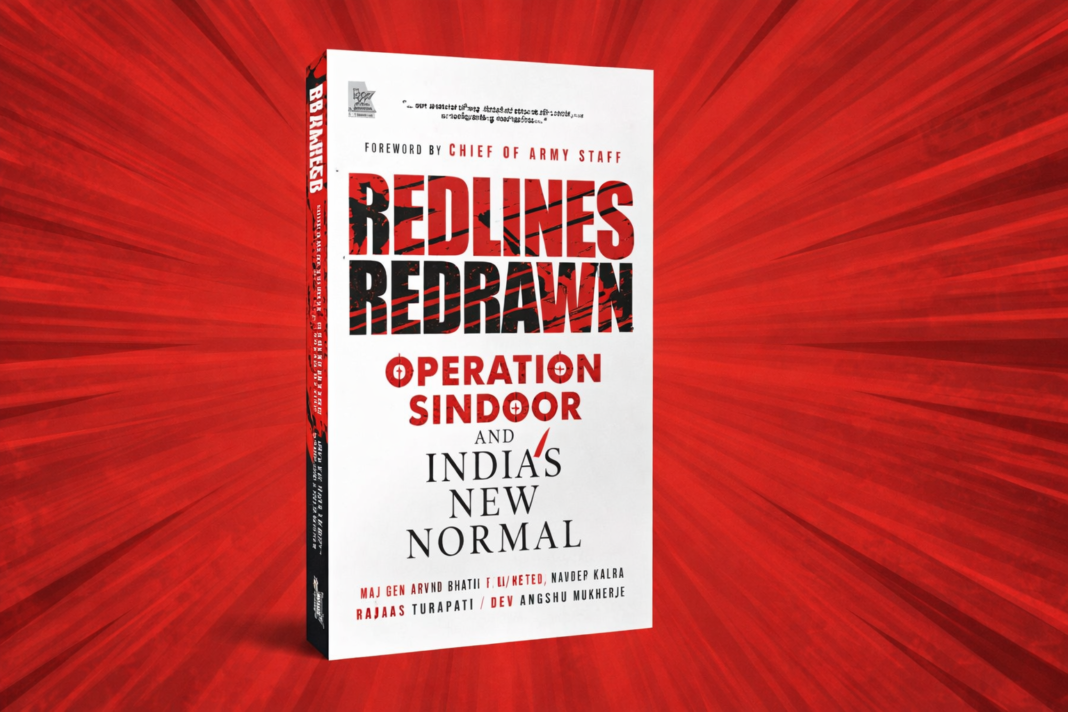

New Delhi: Redlines Redrawn: Operation Sindoor and India’s New Normal is a new book published by Konark Publishers Pvt Ltd that provides the most detailed academic analysis to date of an operation that, according to its authors, has radically changed the nature of engagement between India and Pakistan.
The book is a phenomenal compilation of wisdom. Maj Gen Bipin Bakshi (Retd) is a veteran paratrooper and former Inspector General of the National Security Guard, offering his extensive knowledge of special operations and counter-terrorism. Air Mshl Rajesh Kumar (Retd), the former Commander-in-Chief of the Strategic Forces Command, having served the Indian Air Force for over four decades, provides unmatched insights into nuclear aspects and air operations.
What is even more intriguing is that the book is written by an Indian Ambassador, Anil Trigunayat, who served as an Indian ambassador to the Middle Eastern nations of Jordan and Libya and to Malta and is now a distinguished fellow in the Vivekananda International Foundation, who navigates through the geopolitical currents that influenced the conflict. Brig Akhelesh Bhargava (Retd), a life member of the Centre for Land Warfare Studies, offers his considerable experience in Army Air Defence to the examination of one of the most important areas of the conflict.
Their collaboration has produced a work that is both an operational chronicle and a strategic treatise and a policy blueprint. The foreword, written by the Chief of Army Staff, praises the book as an excellent cooperative effort that encapsulates a seminal chapter in the strategic development of the Indian Army by highlighting how it portrays the combination of military accuracy, diplomatic vision, and technological advancement, which has made up the present-day Indian Army transformation of a decade.
Pahalgam Affair
The book begins with creating the important context that defines the entire book, the long-term proxy war between Pakistan and India, with its epicentre being in Kashmir. The authors follow this tactic to the declaration of a thousand cuts that were supposed to haemorrhage India by the use of low-cost terrorism. This was not a one-time event as they claim, but a state policy that the military establishment of Pakistan had been handling for decades.
The catalyst for the operation Sindoor was on 22 April 2025. What makes this book stand out from journalistic narratives is its detailed account of the investigation and decision-making procedures that ensued. The authors explain how early studies established the role of the deep state in Pakistan, which triggered a measured backlash that had been perfected in the preceding operations.
The next step was not the knee-jerk reaction but the implementation of the doctrine that had been developing since the 2016 Surgical Strikes and the 2019 air strikes against Balakot. The authors state that these operations, along with Operation Sindoor, can be viewed as a logical continuation of India’s strategic thinking, a shift from a reactive posture to a cost-inflicting retaliation.
Doctrinal development
It is arguably the greatest contribution of Redlines Redrawn, as it provides an in-depth examination of India’s changing military thinking. The authors pay close attention to the Cold Start Doctrine, which was expounded by the former Chief of Army Staff, General NC Vij, in his newly published book, Alone in the Ring. The Indian Army had strategised eight to ten small operations into Pakistan up to 10 to 15 kilometres respectively, all this to be carried out in 96 hours under Cold Start and without Pakistan taking a nuclear step.
The authors trace the lineage of the doctrine even further, to the Sundarji Doctrine of the 1980s that focused on mechanisation and manoeuvre in the traditional battle. They observe that the massive troop mobilisation of 2001-2002 was a failure due to three factors: the modified nature of the Pakistan proxy war in Kashmir, the new calculus of escalation that the 1998 nuclear tests had brought and the inability of holding corps to carry out rapid offensives without the strategic surprise that had been part of the large scale mobilisation.
The authors suggest that Operation Sindoor is the realisation of a new strategy. They describe it as the Indian Dynamic Response Military Doctrine, a model that includes more actions within a steeper escalatory hierarchy. Importantly, they observe that the Joint Doctrine of the Indian Armed Forces 2017 already predicted this development, stating that surgical strikes would be a component of a credible deterrence posture based on punitive destruction and interference in a nuclear setting.
The main idea of this new doctrine is the principle of control of escalation. The authors cite the commentary of Air Chief Marshal AP Singh, who, after Operation Sindoor, said that the world could take a lesson as to how India could initiate and end a war within a short period of time. This calibration of response – to use just the right degree of force required to reach the political goals without causing unintended escalation – is put forward as the mark of strategic maturation that India experienced.
India’s new strategy
The book has cited three pillars that constitute the transformed Indian approach to counter-militancy. To begin with, forceful retaliation against the enemy with disproportionate costs. Second, the abolition of any differentiation between militants and their sponsors in the state, which is a principle that makes the military establishment of Pakistan directly responsible for the acts of proxy groups. Third, a proclaimed policy of zero tolerance towards nuclear blackmail, which will signal to China that the risk of retaliation will no longer prevent India from retaliating against provocation.
According to the authors, this shift in the doctrine has already proven credible. They note that the time interval between major attacks has been increasing since the 2016 surgical attacks, as Pakistan is being calculated differently by the reality and severity of Indian retaliation.
Operational canvas
The doctrinal analysis is the book’s main argument, but the operational narrative offers a thrilling account of how the new doctrine was implemented. The authors report on how the Indian Army destroyed seven militant camps on 7 May 2025 and vigorous activity in the Rajouri and Baramulla fronts, where degradations of Pakistani positions had been heavy.
Special attention is paid to the air dimension. The authors report on the air defence battle in Indian skies, where hundreds of drone attacks were observed each night, which is also a revelation that highlights the changing aspect of air warfare. They scrutinise the essential functions of space-based assets and note that the Navigation with Indian Constellation (NavIC) satellite system’s essential nature was clear during operations.
The book also provides insight into aspects of the war that were under the spotlight, such as naval and computational activities. The authors propose that the maritime domain, especially, is a place of activity of utmost gravity, which may be significantly more active in the future upheavals, and they support the further development of naval capabilities.
Another common theme in the operational analysis is that indigenous defence hardware has been battle-tested successfully. With gratification, the authors note that Indian-produced systems did quite well, but they are also unsure whether the scale of indigenous production is sufficient and whether bureaucratic barriers stand in the way of rapid innovation.
Geopolitical chessboard
At the geopolitical level, the analysis is where the author’s diplomatic skills, Ambassador Anil Trigunayat, are applied. The authors paint a complex picture of Pakistan’s strategic position, portraying a nation that attracts both the United States and China’s backing in a strategy they call a masterclass in duplicity.
They cite the history of Pakistan as a platform of American operations in Afghanistan and its continued usefulness to the United States as a viewing point over China and a platform to act against Iran. At the same time, they outline the China-Pakistan Economic Corridor and the connection that the leaders of Pakistan define as being higher than the mountains, deeper than the oceans, stronger than steel and sweeter than honey.
This is the twin alignment, the authors say, which helped Pakistan to maintain its militant infrastructure in the face of international pressure. They are concerned about what they describe as the ongoing involvement of the United States with the military establishment of Pakistan, citing the invitation sent to the Army Chief of Pakistan to a White House lunch in June 2025, just after the “fiasco” experienced by Pakistan in Operation Sindoor, as evidence of a relationship based less on responsibility over state-sponsored terrorism and more on strategic convenience.
The authors also focus on the development of relations between Pakistan and Turkiye and Azerbaijan, which took advantage of the fact that Pakistan had the only Islamic nuclear bomb and would use this fact to attract the support of the Islamic world. Such a cocktail of conflicting interests, coupled with what the authors term as the “malignant hatred” that the Pakistan Army has cultivated against India over decades, leaves little room for detente.
Information war
Among the most futuristic parts of the book is the discussion of what the authors call the struggle in the cognitive domain. They cite Maj Gen Bakshi’s PhD thesis on Information Warfare to argue that the existing structures of strategic communication and information warfare in India remain disjointed and under-resourced.
The authors compare the case in India to opponents who have institutionalised information operations, centralising capabilities in organisations operating across the cyber, electronic, psychological, and media spaces. They observe the potential displayed by the Inter-Services Public Relations organisation of Pakistan in operation Sindoor, and that India may lose out in this important dimension unless it adopts a similar national-level architecture.
The authors caution that countries that opt to disregard this important factor will inevitably suffer losses and face-offs in peace, conflict, and war, as the growing number of adversaries or competitors will adopt an increasingly integrated approach to Information Warfare.
They propose the formation of a Central Information War Room with 24/7 response capability, a pool of expertise, and specific training in narrative building and information warfare. They also demand the creation of information warfare specialists as a separate vertical with a career ladder that is not dependent on the current tenure-based model.
The authors observe that a Strategic Communication Agency is supposed to be instituted within the Headquarters Integrated Defence Staff, a move they term a good step towards a stronger national-level body.
Way forward
The final chapters of ‘Redlines Redrawn’ provide a detailed system of recommendations that can be used to unify the benefits of Operation Sindoor and prepare for the challenges in the future. The authors emphasise the importance of rapid modernisation and indigenisation, which should be prioritised in critical technologies such as high-power jet engines, hypersonics, long-range precision weapons, artificial intelligence, and the advancement of air defence systems.
They demand that the Indian Air Force fighter fleet be reinstated to its authorised strength of 42.5 squadrons, as well as immediate procurement of additional flight refuellers and Airborne Early Warning and Control aircraft. They also note that there must be similarity between the Air Force’s fighter fleet and the Navy’s carrier-based fleet, specifically referring to the Rafale platform in service with both services.
On the geopolitical front, the authors propose an active approach that reinforces alliances through frameworks such as I2U2 and the Quad, while utilising platforms such as the G20 to introduce India as a stabilising power. They demand further efforts to seek the Comprehensive Convention on International Terrorism at the United Nations and push the Financial Action Task Force to re-add Pakistan to the greylist.
A sense of urgency pervades these recommendations. The authors state that operation Sindoor is still ongoing, a reminder that the war did not end with the cessation of hostilities on 10 May 2025 but instead manifests in new forms. They state that it is not enough to plan to be future-ready; India must be ready now, giving urgency to the reforms to be made, so that tomorrow the nation can fight the war today.