


New Delhi, April 9: What is non-alignment? What is the difference between this and multi-alignment or strategic diversification? Is it simply an archaic variant of Cold War foreign policy, or does it harbour within it a more radical political vision that is relevant to our own epoch?
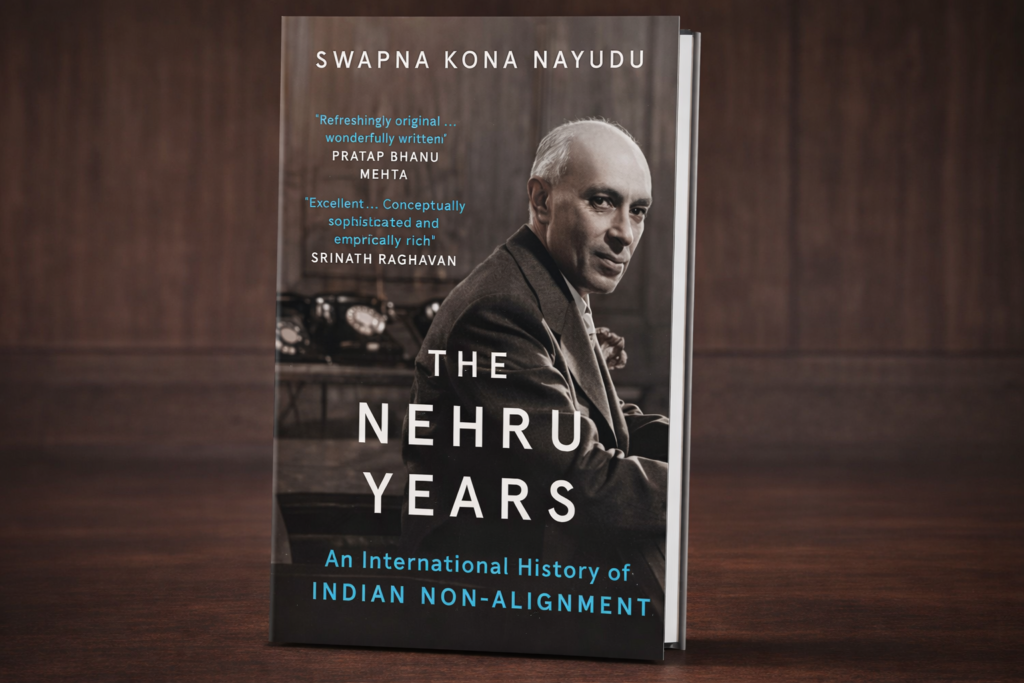
A recent book, The Nehru Years: An International History of Indian Non-Alignment by Swapna Kona Nayudu, published by Juggernaut Books, provides a highly researched and conceptually advanced response to these questions.
Nayudu is a lecturer of Social Sciences (Global Affairs) at Yale-NUS College, Singapore, and a member of the Advisory Board of the Association of Global Political Thought of Harvard University, where she earned a PhD in War Studies at King’s College London.
The politically transformative quality of war is the subject of her work. She uses archival research in various languages in this book to trace Indian diplomatic influence in four major international crises: the Korean War, the Suez Crisis, the Hungarian Revolution, and the Congo Crisis.
The book has already received widespread acclaim from prominent scholars. Pratap Bhanu Mehta of Princeton University calls it a very fresh and unusual treatment of non-alignment, which is a very lively way of rescuing non-alignment from the history of the Cold War and of putting it into a broader ethical context that is deeply concerned with war and politics.
Srinath Raghavan of Ashoka University calls it excellent, a long-needed re-evaluation and a seamless combination of intellectual and international history. Oxford University professor Faisal Devji praises it as a strong argument for non-alignment as an exceptionally innovative way of thinking about and reinventing the international order.
Out of the Cold War frame
The main thesis of The Nehru Years is that non-alignment cannot be viewed as a Cold War phenomenon only (or even first and foremost). Nayudu writes that the first order of the book “is to disrupt that assumption.” Instead, she is drawn to the non-aligned thinking roots of the fin de siècle, demonstrating that non-alignment was an anti-imperial politics that existed before and after the Cold War.
Nayudu points out that although we can consider non-alignment only in the context of the Cold War, it actually enables us to conceptualize the Cold War in other ways. It is also a history of the Cold War, which is a history of non-alignment, she writes. To be more provocative, she implies that, first, most of the history of the Cold War is the history of decolonisation.
This reframing implies a lot. Nayudu believes that the concept of the Long Peace, which has predominated Cold War historiography, is infuriating and wearying because of its insensitivity to the Indian experience of the Cold War. She sometimes argues that the Cold War remained cold because of the gigantic, planet-changing role of Afro-Asian nation-states in keeping great-power politics in check. Non-alignment paused during a period when capitalism and socialism tried to outcompete one another.
An intellectual family
The book begins with an imaginary history of the international and political thought of Rabindranath Tagore, Mohandas Karamchand Gandhi, and Jawaharlal Nehru.
According to Nayudu, the three thinkers have been reduced to a kind of liberal thought. She sees them instead as introducing India’s radical ideas to the world. Their visions are relevant to this discussion too, since they are incompatible with each other-their arguments give us good service to dismantle the myth of a monolithic Indian political tradition, and even less a liberal one.
There were mutual obligations within this tradition in the field of anticolonial thought, which Nayudu believes is essential to the theorisation of the Indian nation-state in the international system. Also, to these Indian thinkers, the anticolonial needed to be engaged as a political entity, but not merely as a historical category.
According to Nayudu, Indian anticolonialism had radical philosophical prospects and expanded the outlook of twentieth-century politics beyond liberal internationalism.
Nehru, she contends, holds a special place in this lineage. The years preceding India’s independence in 1947, during which India found itself in a curious state between colony and nation, were a most fruitful period for Nehru. Anticolonialism remained central to his political ideas even after India gained independence from British rule.
Nayudu contends that the fears of the unusual conditions a war would impose and his acknowledgment that any conditions surrounding a war were extraordinary propelled the opposition to the specter of war to the heart of the non-aligned political project.
Lonely furrow
The book’s chapter titles are the descriptions Nehru gave of the events being studied. By claiming that India is ploughing a lonely furrow, Nayudu writes, he was saying that non-alignment is isolating India, which Nehru was trying to counteract with the practice of diplomacy.
The Korean War had taken many unexpected turns, but when an accord was unexpectedly reached between the two superpowers, Nehru referred to it as an outbreak of peace.
Nayudu examines India’s participation in the Korean War, especially in the second phase and in ending the war by successfully brokering an armistice truce between 1950 and 1953. This history, she claims, is informative because it describes India’s mediating diplomacy.
The two crises that occurred in 1956 were closely related in time; that is, they occurred nearly simultaneously. India once again played a mediatory role in the Suez Canal Crisis. Indian empathy towards the Egyptian cause and anticolonial zeal during the crisis did not prevent India from intervening between the two parties, which helped end the crisis.
In Hungary, Nehru faced significant international and domestic criticism for India’s tardiness and ambiguity in responding to the Soviet crackdown on the revolution.
Nayudu interprets the two separately as a discursive moment: Indian non-alignment as a mode of world politics facing its initial challenge.
The limits of non-alignment
The Congo Crisis of 1960-1964 gets the story much further off the critical stance that non-alignment assumed in the early 1950s. According to Nayudu, the introduction of peacekeeping and the UN’s dependence on Indian troops for its survival and success in the Congo exposed India to swift alienation by African member states and cost India the lives of its citizens.
She remembers when Nehru, decades ago, declared that a patched-up unity could only lead to bad ethics and worse policy. With Indian troops casualties in the Congo and African states now alienated to Indian intervention in the Congo crisis, the borders of non-aligned solidarity became excruciatingly clear.
Weak political vision
The epilogue of the book offers concluding remarks on how we can be critical of non-alignment and what can be learned from a lessened political vision. Nayudu is not an apologist. She acknowledges the reversals in India’s foreign policy, which were soon overshadowed by problems on India’s borders with China and, eventually, the Sino-Indian War.
But she says that the non-alignment is still worth reading, not to teach anything about the present, but for what it teaches about the past. Nehru, she writes, is not a thinker of our century. His thought had in it very little of the last century, and yet the epoch in which he lived is, in turn, enlightened by his thought, and must thus claim our notice even though we should illuminate the past with but slight teaching to us.
An indispensable contribution
The Nehru Years is a global history of non-alignment that sees non-alignment as a counter to ideological politics. Nayudu states that non-alignment was the construction of historical consciousness, and the initial job was to discover other political visions, their historical roots, and their manifestos.
She pays attention to the issue of why political projects fail, and what the projects themselves are not recognised as political in the first place. The failure of any political project is noteworthy, she writes, in the sense that it seeds within it the germs of a different political imaginary and possibilities of regeneration.
To the international relations scholars and modern Indian history and Cold War scholars, Nayudu has made a contribution that cannot be ignored. It restores a decolonial political thought tradition that has been whitened out of the International Relations theory through a process of selective redaction. And it demands to see non-alignment not as an inactive non-intervention or a balancing cynicism, but as a positive and complex vision of the world and its political future. So it reinstates the Indian foreign policy that Nehru himself introduced, namely, intellectual earnestness and moral aspiration.
Daanish Bin Nabi can be reached at daanishoffice@gmail.com