


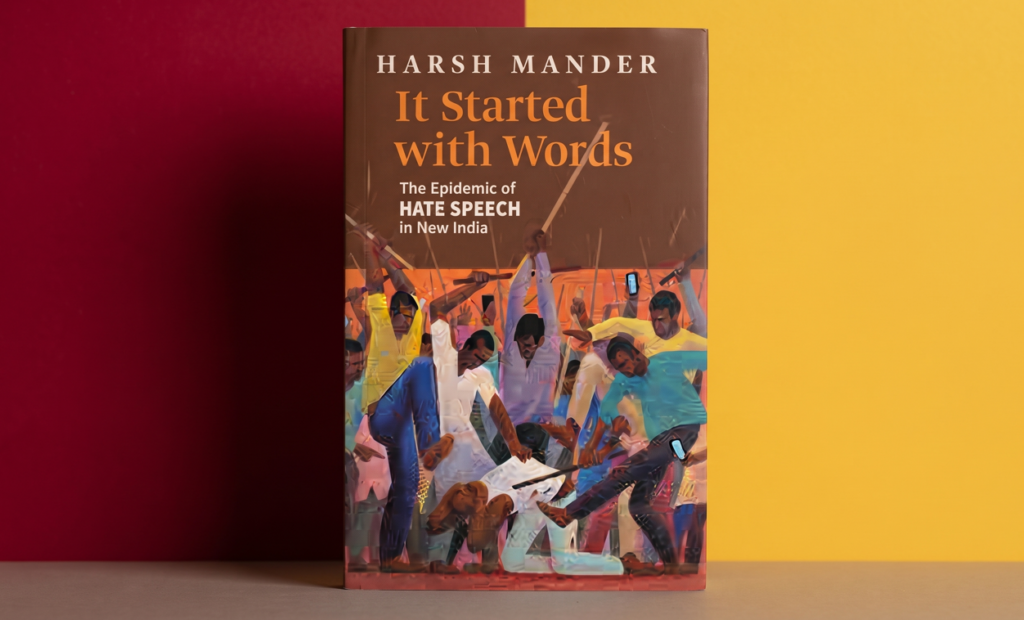
New Delhi: Holocaust survivors used to say that the genocide did not begin in the gas chambers; it began with words. Harsh Mander borrows that premise for the title of his new book, It Started with Words: The Epidemic of Hate Speech in New India, published by Speaking Tiger Books, and then spends the next several hundred pages demonstrating how precisely that sequence is unfolding in contemporary India.
This is not a work of detached scholarship. It is a document of witness, written by a man who has spent his adult life in active resistance to the very hatred he is describing, and who now finds himself asking whether the law that is supposed to protect the vulnerable has become another instrument in the hands of those who incite fear.
Mander’s central argument is deceptively simple: violence does not erupt without preparation. It is preceded by a long, patient accumulation of language that first construes a minority as hateful, disloyal, sexually predatory and undeserving of equal citizenship, and then gradually makes violence feel almost incidental.
Since 2014, he writes, hate speech in India has moved from the political fringe to the centre of public life, heard from election platforms and religious stages, repeated in television studios, circulated through WhatsApp and YouTube, and rewarded with votes, influence and profit.
The book’s achievement lies not in identifying this phenomenon, many have, but in tracing its machinery with the patience of an investigator who understands that the production of hatred is a system, not a series of accidents.
Drawing on case studies, including his own attempt to seek legal action against politicians for incendiary speeches delivered before the Delhi riots of 2020, Mander examines how hatred is produced, spread and protected, and who profits from it.
The answer, unsurprisingly, implicates political leaders, religious figures, social media influencers and ordinary users, but Mander is most compelling when he turns to the question of law.
Regulating hate speech means handing that power to the very state that is producing so much of it, and Mander illustrates the absurdity of this arrangement with a detail that lands like a blow: Kapil Mishra, against whom Mander once petitioned over hate speech during the Delhi riots, is now a minister for law and justice.
How, Mander asks, can anyone trust such a state to regulate the speech it depends upon?
The book arrives at a moment when the language of hate has become so normalised that its repetition no longer provokes shock. At the book’s launch in New Delhi, the writer and activist Farah Naqvi observed that bearing witness interrupts this normalisation, that an outrage heard once is shocking but heard a hundred times becomes simply what “they” say.
Mander’s book is, in essence, an act of disciplined record-keeping, a refusal to let the accumulation of words pass unremarked.
He documents the “shadow advertisers” who circulated political advertisements during the 2024 Jharkhand assembly elections, the anonymous pages that placed almost five times as many advertisements as the official BJP account and generated four times as many views.
He notes that social media platforms, once imagined as engines of democratic speech, have been hijacked to manufacture consent for majoritarianism.
What distinguishes Mander’s work from polemic is its grounding in lived experience. He has stood in resistance to the culture of hatred he describes, and the book carries the moral authority of someone who has not merely observed but participated in the struggles he documents.
This is both its strength and its limitation. Readers already persuaded will find their convictions sharpened; readers who are not will find little here to change their minds. But Mander is not writing for the unconvinced.
He is writing to document, to warn, and to insist that the sequence from words to violence is neither inevitable nor invisible.
It Started with Words is a book about how violence begins long before the first blow is struck. It is a warning about the direction in which India is being pushed, and it makes a case that no concerned citizen can afford to ignore. Whether the warning is heeded is, of course, another matter entirely.