


The memory of the devastating floods of 2025 remains raw and deeply etched in the collective psyche of Jammu and Kashmir. Few can forget the fury of the floodwaters that swept away infrastructure, destroyed personal property, and tragically claimed the lives of many of our loved ones. I, too, carry the weight of those memories, which is why a recent opportunity offered a genuine glimmer of hope.
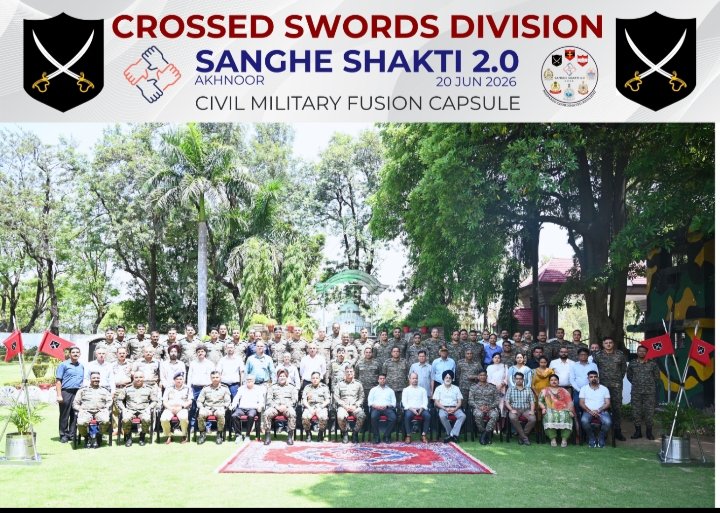
I was deputed by Prof. S.K. Pandita, Director of the Disaster Management Centre (DMC), University of Jammu, to participate in and share our experiences at Sanghe Shakti 2.0, a commendable disaster management initiative organised by the Akhnoor Brigade of the Indian Army. The programme was a remarkable example of civil-military fusion, bringing together the armed forces, civil administration, local communities, and academia on a common platform. Witnessing the Army take the lead in fostering such coordination was reassuring, while the comprehensive and multidimensional discussions inspired confidence that, if implemented effectively, the strategies deliberated upon could significantly reduce the impact of the upcoming monsoon season in the region.
During the deliberations, a point was raised regarding the India Meteorological Department’s (IMD) prediction of a “low to moderate” monsoon this year. However, several experts and I cautioned against complacency. Past experiences serve as a stark reminder that disasters do not always follow forecasts. The Chashoti tragedy in Kishtwar remains a glaring example. Although there was no visible rainfall in the immediate vicinity, a localized cloudburst in the upper reaches triggered catastrophic downstream flooding, causing immense loss of life and property.
Disasters do not adhere strictly to weather predictions; therefore, we cannot afford to wait for an IMD warning before activating preparedness measures. Instead, we must maintain a constant state of readiness, much like the proactive posture adopted by our armed forces. Encouragingly, the Department of Disaster Management, Relief, Rehabilitation and Reconstruction (DMRRR) has been working tirelessly to address these challenges. The department has been deploying expert teams to assess landslide-prone areas, engage with local administrators, and implement immediate mitigation measures based on scientific recommendations.
While such macro-level initiatives are important, the heart of any disaster preparedness strategy must lie in strengthening local capacity. Jammu and Kashmir’s vast, rugged, and vulnerable terrain makes it impossible for government agencies to reach every affected area immediately during emergencies. One of the central themes of Sanghe Shakti 2.0—and a concept long advocated by the Disaster Management Centre, University of Jammu—is the institutionalisation of local volunteerism.
To encourage active community participation, district-level events such as water sports competitions, white-water rafting activities, and river festivals could be organised as part of flood preparedness campaigns. Integrating these events with swift-water rescue demonstrations and emergency response simulations would make disaster preparedness engaging and community-driven rather than burdensome. By training local residents, providing them with certification, and embedding safety drills into community culture, we can establish an effective first line of defence against disasters.
Global examples such as Japan demonstrate how disaster preparedness can become an integral part of civic culture, with local knowledge effectively utilised by authorities. Although India has moved from a relief-centric approach to a preparedness-based framework, progress remains slow. Given our dense population and ecological vulnerabilities, there is an urgent need to accelerate these efforts.
It is also important to recognise that the involvement of the armed forces in civilian disaster response should ideally remain a last resort, as their primary responsibility is national defence. While the military’s leadership in initiatives such as Sanghe Shakti 2.0 is highly commendable, it does not absolve citizens of their responsibilities.
True disaster resilience requires structural changes in the way we live and build. This includes adopting eco-friendly construction practices that respect natural topography, keeping drainage channels and nallahs free of debris and encroachments, and reducing excessive concretisation. Preference should be given to natural bunds wherever feasible, while households should preserve open, unpaved spaces to facilitate groundwater recharge and reduce surface runoff.
On the educational front, it is encouraging that the Ministry of Education and the University Grants Commission (UGC) have incorporated Disaster Management into mainstream academics and competitive examinations such as the NET. This step will attract talented young minds to the field and help establish disaster management as a robust professional discipline.
Ultimately, disaster mitigation cannot be achieved in isolation. It demands a unified approach that combines academic expertise, military-style discipline, administrative commitment, and, above all, active community participation. The blueprint has already been laid out at Akhnoor through the collaborative efforts of the Army, civil administration, academia, and local stakeholders. It is now up to all of us to transform preparedness into a way of life across every corner of the Union Territory of Jammu and Kashmir.