


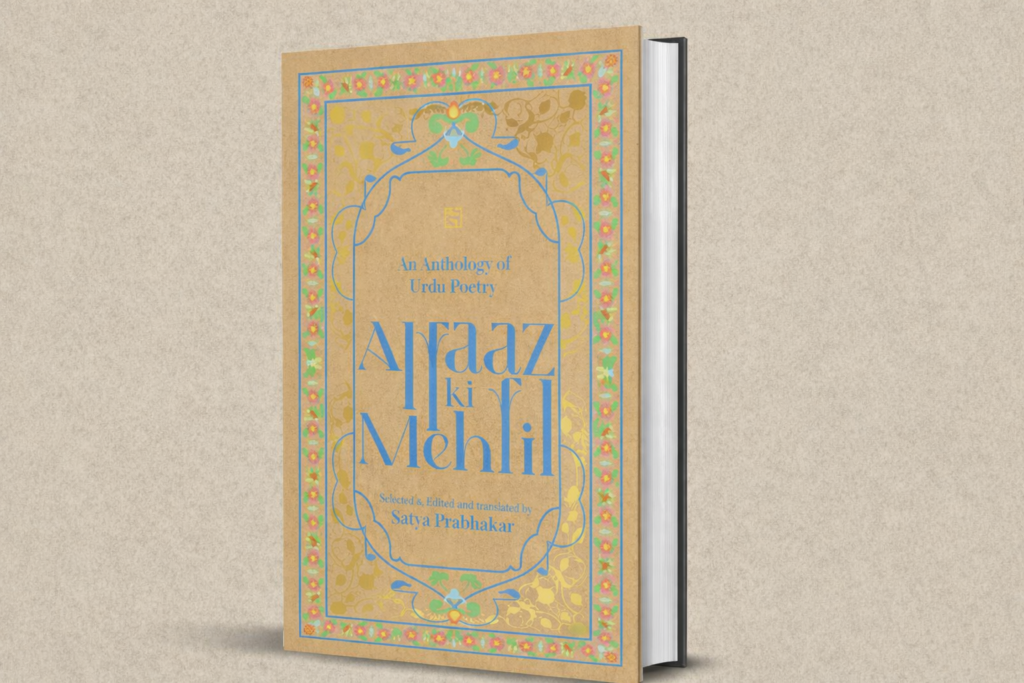
New Delhi: The journey that led to Alfaaz ki Mehfil began not in the musty archives of a university library, not in the hallowed halls of literary scholarship, but in the quiet hours of a nationwide lockdown, when a computer scientist stumbled upon an Urdu sitcom on YouTube. Six years later, Satya Prabhakar, an NIT Trichy Distinguished Alumnus with graduate degrees from the University of Florida, has produced a collection that seeks to bridge the gap between a centuries-old poetic tradition and a generation with little exposure to the language.
The book, published by Hachette India, is a sincere and carefully curated collection of shers and ghazals that spans over 300 years of literary history. Divided into five thematic sections, it underscores love, loss, resistance and remembrance through the lens of literary stalwarts like Mir Taqi Mir, Ghalib, Allama Iqbal, Faiz Ahmed Faiz, and contemporary voices such as Rahat Indori and Aleena Itrat.
What makes the anthology particularly noteworthy is its origin story. Prabhakar, whose professional background lies in technology and business, found himself drawn to the sound of Urdu during the lockdown.
“The sound of Urdu, just the sound, drew me powerfully. Musical. Warm. Evocative. Courteous. Poetic. Magical. I started learning a few words a day,” he recalled during a recent event in Chennai.
That initial fascination grew into a four-year project, during which he translated a couplet a day, working for just fifteen minutes each session, to build what he describes as a “curated bouquet” rather than an academic canon.
Prabhakar’s selection process was driven by resonance rather than scholarly obligation. He sought shers that would land with readers who have zero background in Urdu, choosing couplets that moved him personally on themes ranging from love and rebellion to doubt, irreverence and the divine.
“Honestly, I brought the ones that moved me most personally,” he said. “When you have spent years with a poet’s work, and the book spans over 300 years, from Mir Taqi Mir to contemporary voices, you develop a relationship with certain shers.”
This approach has yielded a collection that one reviewer describes as spanning over 300 years, featuring more than 250 couplets and ghazals from over 100 poets, and presenting the Urdu text in Roman script alongside simple English translations.
The challenge of translation looms large in any work of this nature, and Prabhakar is candid about its difficulties. There are Urdu words, he notes, that have no English equivalent. He cites examples like Irfan, which is not merely “awareness”; intezaar, which extends beyond “waiting”; and dard, which carries a weight far heavier than simple “pain.” These words carry centuries of usage, what Prabhakar calls “specific emotional weather.”
His approach has been to prioritise honest prose over forced rhyme and to preserve simplicity over adornment, ensuring that the emotional core of each sher remains intact even for those unfamiliar with the original language.
Readers have responded to the collection with a sense of discovery. One review captures the experience of sitting with the book: “This book isn’t something you just read, it’s something you experience slowly,” noting that the anthology’s strength lies in its ability to bring together poets from different centuries while making their emotions feel present and alive.
The same reviewer singles out two verses that have lingered in memory: Allama Iqbal’s famous call to selfhood, “Khudi ko kar buland itna ke har taqdeer se pehle/Khuda bande se ye poochhe, bata teri raza kya hai,” and Brij Narain Chakbast’s reflection on love’s necessity: “agar dard-e-mohabbat se na insaan aashna hota / na kuchh marne ka gham hota na jeene ka maza hota.” These couplets, the reviewer notes, remind readers that without the pain of love, life would lose both its sorrow and its sweetness.
The book’s thematic organisation across five sections traces the evolution of Urdu expression from elegiac melancholy to fiery social commentary. A publisher’s note describes it as “a collection, both spare and luminous, for those well-versed as well as new to this world,” praising the way Prabhakar navigates the inherent challenges of translation by prioritising rhythmic fidelity and emotional resonance over literalism.
Prabhakar, for his part, does not claim to be a scholar of Urdu. His ambition for the book is more modest but perhaps more profound. “I hope that the book is a door,” he told an interviewer.
“What’s behind it belongs to the poets.” He describes Urdu poetry as having “remarkably high ROIC, Return On Invested Capital. You put in fifteen minutes, you get back something life-changing.”
For the reader who picks up this anthology, the promise is that of sitting in a mehfil where poets from different centuries gather, and where the beauty and fire of a rich literary tradition are made newly accessible.