
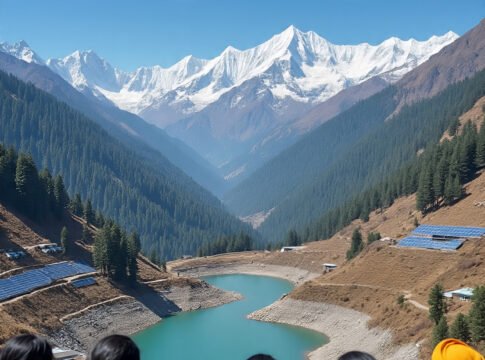

Climate change is one of the most pressing issues of our time, with far-reaching consequences for human societies and natural ecosystems. Rising temperatures, melting ice caps, and extreme weather events are just a few of the many impacts of this global phenomenon.
The year 2025 was one of the warmest on record. There has been a continuous surge in extreme weather events, including heatwaves, droughts, and intense storms. The consequences are far-reaching, from devastating wildfires to crippling floods. Coastal cities and low-lying areas face increased flooding and erosion, displacing millions of people. Changes in precipitation patterns lead to droughts in some regions, threatening agriculture and human consumption. Intensifying heatwaves, storms, and wildfires have catastrophic impacts on ecosystems and human societies. Climate change is also accelerating species extinction, compromising ecosystem services and human well-being.
India is particularly vulnerable to climate change, with rising temperatures, changing monsoon patterns, and increasing extreme weather events. The country has already experienced significant climate-related disasters, including heatwaves, floods, and droughts, affecting millions of people.
Climate change is contributing to the melting of polar ice, which weakens Western Disturbances, reducing winter precipitation in the Himalayas. Cooling of Pacific Ocean temperatures reduces temperature gradients, while random fluctuations in air pressure also impact the frequency and intensity of Western Disturbances. These changes have significant implications for India’s water security, agriculture, and regional climate risks.
Weakened Western Disturbances also pose a threat to the climate of Jammu and Kashmir. These extra-tropical storm systems, originating in the Mediterranean region, play a crucial role in bringing winter precipitation to the region.
The weakening of these systems has resulted in reduced snowfall in Jammu and Kashmir. This decrease has led to drought-like conditions. Scant snowfall in Kashmir may lead to meteorological drought, affecting water security, agriculture, and hydropower generation. Additionally, weakened Western Disturbances are shifting snowfall timing, with heavy snowfall now occurring later—mainly in February and March rather than November and January—reducing long-term water availability.
Altered precipitation patterns have far-reaching implications for Jammu and Kashmir’s agriculture and economy. Erratic rainfall and reduced water availability affect crops such as paddy and horticulture orchards. Decreased snowfall deters tourists, impacting local businesses and livelihoods. Reduced water availability also affects hydropower production, exacerbating energy shortages.
To mitigate the impacts of weakened Western Disturbances, Jammu and Kashmir can adopt and promote drought-tolerant crops and efficient irrigation systems, implement water conservation measures, and develop early warning systems and emergency response plans.
The changing climate poses significant challenges to Jammu and Kashmir’s ecosystem and economy. Understanding the impact of weakened Western Disturbances is crucial for developing effective adaptation strategies.
According to the UN, global surface temperature has increased faster since 1970 than in any other 50-year period over at least the last 2,000 years. The Earth is now about 1.42°C warmer than it was in the pre-industrial era (1850–1900). The year 2024 was the warmest on record, with the global average near-surface temperature about 1.55°C above the pre-industrial baseline. The decade from 2015 to 2024 has been the warmest recorded.
Monthly or annual temperatures above 1.5°C do not necessarily mean that the world has failed to achieve the Paris Agreement target, as it refers to long-term temperature rise over decades rather than short-term fluctuations. These variations are influenced by natural factors such as El Niño, La Niña, and volcanic eruptions.
About 90 percent of the excess heat from global warming is stored in the oceans, making ocean heat content a critical indicator of climate change. Today, the oceans are the warmest ever recorded, not only at the surface but also up to depths of 2,000 meters. Glaciers worldwide have thinned by an average of one meter per year, and sea levels rose at a rate of 4.7 mm per year between 2015 and 2024. Greenland and Antarctica lost 38 percent more ice between 2011 and 2020 than during 2001–2010.
Every fraction of a degree of warming matters. With each additional increase, the intensity and frequency of extreme weather events rise. For example, every 0.5°C increase in global warming significantly increases temperature extremes, precipitation variability, and agricultural and ecological droughts in some regions.
Greenhouse gas emissions reached a record high of 57.7 gigatonnes in 2024. They must drop by 55 percent by 2035 (compared to 2019 levels) to keep temperature rise below 1.5°C. Under current policies, the world is on track for a global temperature rise of 2.8°C above pre-industrial levels by the end of the century.
Carbon dioxide (CO₂) is accumulating in the atmosphere faster than at any time in human history, rising by more than 10 percent in just two decades. Global CO₂ concentrations are now 152 percent higher than in the pre-industrial era.
The emissions gap in 2030—the difference between required reductions and current trends—is estimated at 20 gigatonnes of CO₂ equivalent to limit global warming to 1.5°C.
The reduced snowfall this year has raised serious concerns across India, particularly in the Himalayan region. The consequences are far-reaching, affecting water security, agriculture, and the overall ecosystem. Rising global temperatures are altering precipitation patterns, leading to decreased snowfall. Changes in atmospheric circulation are reducing the frequency and intensity of Western Disturbances. The variability of the jet stream is also impacting snowfall patterns in the Himalayas.
Reduced snowfall leads to decreased water availability, affecting drinking water supplies and agriculture. Lower water levels in rivers and reservoirs impact hydropower production, worsening energy shortages. Insufficient snowfall also affects crop yields, leading to economic losses for farmers.
Furthermore, reduced snowfall accelerates glacier melting, threatening long-term water security. It disrupts ecosystems, affecting flora and fauna adapted to specific snow conditions. Winter tourism declines, impacting local economies. Farmers, herders, and those dependent on snow-related activities face economic hardship. Decreased agricultural productivity also threatens food security, particularly in vulnerable communities.
The impact of reduced snowfall is a pressing concern that requires immediate attention and collective action. By adopting sustainable practices and strengthening climate resilience, we can mitigate the effects of this growing threat.
The writer of this article can be reached at Sajjadiqbal107@gmail.com